Monday, February 06, 2012

Brain Hacking: Homebuilt tDCS and More

Stuart Gromley sits hunched over a desk in his bedroom, groping along the skin of his forehead, trying to figure out where to glue the electrodes. The wires lead to a Radio Shack Electronics Learning Lab, a toy covered with knobs, switches, and meters. Even though he’s working with a kiddie lab, Gromley, a 39-year-old network administrator in San Francisco, can’t afford to make mistakes: he’s about to send the current from a nine-volt battery into his own brain.

Gromley’s homemade contraption is modeled on the devices used in some of the top research centers around the world. Called transcranial direct current stimulation (tDCS), the technology works on the principle that even the weak electrical signals generated by a small battery can penetrate the skull and affect hot-button areas on the outer surface of the brain. In the past few years, scholarly research papers have touted tDCS as a non-invasive and safe way to rejigger our thoughts and feelings, and possibly to treat a variety of mental disorders. Most provocatively, researchers at the National Institute of Health have shown that running a small jolt of electricity through the forehead can enhance the verbal abilities of healthy people. That is, tDCS might do more than just alleviate symptoms of disease. It might help make its users a little bit smarter. _Phoenix
Rob Zammarch
...tDCS [is] a way to tease apart the mechanisms of learning and cognition. As the technique is refined, researchers could, with the flick of a switch, amplify or mute activity in many areas of the brain and watch what happens behaviourally. The field is "going to explode very soon and give us all sorts of new information and new questions", says Clark. And as with some other interventions for stimulating brain activity, such as high-powered magnets or surgically implanted electrodes, researchers are attempting to use tDCS to treat neurological conditions, including depression and stroke. But given the simplicity of building tDCS devices, one of the most important questions will be whether it is ethical to tinker with healthy minds — to improve learning and cognition, for example. The effects seen in experimental settings "are big enough that they would definitely have real-world consequences", says Martha Farah, a neuroethicist at the University of Pennsylvania in Philadelphia. _Nature
A very dangerous homemade hack for tDCS: Don't try this at home!
Ingredients:
One (1) brain, inside skull
One (1) 9-volt battery
Two (2) wires
Two (2) damp sponges

Instructions:

Attach battery to wires, attach wires to sponges, attach sponges to skull, one over each eyebrow. Simmer once a day until mental health reaches a firm consistency.

It sounds like something you dreamed up in the basement with your stoner friends in high school. (In fact, you may actually have done so.) But transcranial direct current stimulation is the hottest thing to hit the improvisational health management scene since acupuncture. A growing body of evidence suggests that sticking a battery onto your head could hack into your brain's operating system and make life generally more worth living. Think of it as Norton Utilities for the mind.

That's not an oversimplification of the process. tDCS is literally that simple. The total cost of a treatment is less than $5 of parts from Radio Shack and a sponge. No prescription needed. No needles, no pills, no insurance companies, no weird hormonal fluctuations, no commercials saying "I'm glad [drug of choice] has a low risk of sexual side effects!"

An analysis of the pros and cons of tDCS yields fairly impressive results.

PROS
Improved hand-eye coordination
Better memory
Less depression
Recover from brain damage
Less senility
Me talks nice like teacher
Better memory
Control seizures
Cure migraines
Become superior human, crush puny unenhanced inferiors, survive apocalyptic "rise of the machines"
Better memory

CONS
Could end up looking stupid
Small, but not entirely absent, chance of permanent brain damage _longecity
It would be smarter to use more sophisticated devices, following more practised protocols. People will need to proceed with caution, and share insights and mistakes, so that mind hackers can move ahead safely toward their goals.
Researchers at the University of Oxford and University College London studied people with normal math skills using a noninvasive technique called transcranial direct-current stimulation, in which scalp electrodes emit current that modulates neural activity. The team focused on the right parietal cortex because it contributes to spatial and math­ematical thinking. This brain region shows abnormal re­sponses in children with developmental dyscalculia, a learning disability that affects math skills.

Over the span of six days the inves­tigators applied current over the volunteers’ right parietal lobe for 20 minutes at the beginning of training sessions in which subjects learned to associate numbers with arbitrary symbols, such as triangles or cylinders. After practicing, subjects were rapidly presented with pairs of symbols of different visual sizes (using larger or smal­ler fonts), and they had to choose the physically larger one as quickly as they could. In some of the pairs, the physically larger item rep­resented a smaller magnitude—for in­stance, a huge symbol meaning “two” was paired with a tiny symbol representing “five”—­and that mismatch could cause a delay in reaction time because subjects must override their impulse to choose the greater number.

By the fourth day subjects who had their right parietal cortex stimulated became slower for mismatched trials as compared with matched trials, just as adults are when they respond to real digits. But participants who did not receive the same pattern of stimulation showed no difference between these trials, suggesting they had not internalized the symbols’ meaning. The results indicate that right-hemisphere stimulation helps people learn numerical symbols.

The superior performance lasted for six months—a long effect that suggests the method may someday benefit those with developmental dyscalculia, says study co-author Roi Cohen Kadosh, a cognitive neuroscientist at Oxford. _SciAm
Different locations for the electrodes should yield different results from tDCS. The science -- and the hacking -- has barely begun.
[Michael] Weisend, who is working on a US Defense Advanced Research Projects Agency programme to accelerate learning, has been using this form of transcranial direct current stimulation (tDCS) to cut the time it takes to train snipers. From the electrodes, a 2-milliamp current will run through the part of my brain associated with object recognition - an important skill when visually combing a scene for assailants.

The mild electrical shock is meant to depolarise the neuronal membranes in the region, making the cells more excitable and responsive to inputs. Like many other neuroscientists working with tDCS, Weisend thinks this accelerates formation of new neural pathways during the time that someone practises a skill. The method he is using on me boosted the speed with which wannabe snipers could detect a threat by a factor of 2.3 (Experimental Brain Research, vol 213, p 9).

Mysteriously, however, these long-term changes also seem to be preceded by a feeling that emerges as soon as the current is switched on and is markedly similar to the flow state. "The number one thing I hear people say after tDCS is that time passed unduly fast," says Weisend. Their movements also seem to become more automatic; they report calm, focused concentration - and their performance improves immediately.

It's not yet clear why some forms of tDCS should bring about the flow state. After all, if tDCS were solely about writing new memories, it would be hard to explain the improvement that manifests itself as soon as the current begins to flow. _NewScientist
Neuroscientists and cognitive scientists are plodding along in the dark, far more than they will admit. The establishment would like to be able to control potentially transformative and disruptive technologies such as tDCS, and other possibly effective brain boosters. But that is not likely.

Saturday, February 04, 2012

Near Term Plans of the Seasteading Institute

From Russia and the Middle East to western Europe and the United States, dissatisfaction with politics and politicians has led to protest, conflict and, in many cases, violence. But it doesn't have to be that way, according to a US think-tank _SciAm


As long as the Seasteading Institute remains small, and its plans relatively inconsequential, it will not present a threat to the powers that be. Even with the backing of a successful venture capitalist such as Peter Thiel, seasteading will remain small and relatively ineffective -- in terms of meeting its stated goals -- until it gathers enough support structure and enough of a following to present a threat to the current order.

Friday, February 03, 2012

Humans, Apes, Addicts, and Microbes: Common Thread

The common thread that links life on Earth is the thin thread of DNA that coils, circles, and works its way through the generations, through the species, changing the face of the planet as it evolves.
Economist

Our brains are formed by our genes, working through the environment. Some genes control an entire platoon of other genes. The genes that determine how our brains grow and function are still evolving. If these "commander" genes evolve, remarkable changes can occur over a fairly short time span. The human species appears to be changing on a more rapid time scale than most scientists are willing to accept.
...human beings have suites of genes that probably cause their brains to be “plastic” and thus receptive to change far longer (to the age of about five) than is true for chimps or monkeys (whose brains are plastic for less than a year after birth). Moreover, Dr Khaitovich was able to work out how the expression of these modules of genes was co-ordinated, by looking at the switches, known as transcription factors, that turn them on and off.

Indeed, by comparing modern genomes with their discoveries about Neanderthals Dr Paabo’s group has found that the regulatory process for one of the modules came into existence after the modern human and Neanderthal lines separated from one another, about 300,000 years ago. _Economist
Of course, it does no good to have brains that are more plastic, if the caregivers of young children do not take advantage of that period of plasticity to give the children skills, competencies, wisdom, and knowledge that will serve them well throughout their lives.

Some people may be born at a tremendous disadvantage, genetically speaking. Addictive and criminal behaviour appear to be at least partially heritable. Societies deal with these problems in different ways. There is always room for improvement -- beginning with the acknowledgement of the genetic component.

Humans have turned a corner in understanding their own genetics. They can now re-program the genes of living humans, and are on the verge of re-programming the genes of embryos and zygotes. Artificial evolution, in other words.

Humans are also making progress toward understanding the complex genetics of their environments -- the microbial world in which they are immersed. We live in microbial soup, which is quite difficult to sort out with the old genetic tools that required culturing organisms before their genomes could be sequenced.

Now, scientists can extract individual genomes out of the common slurry, and sequence these mystery guests.
To extract individual genomes, Armbrust’s PhD student Vaughn Iverson exploited skills that had he gained as a computer scientist designing video compression technology at Intel in Portland, Oregon. He developed a computational method to break the stitched metagenome into chunks that could be separated into different types of organisms. He was then able to assemble the complete genome of Euryarchaeota, even though it was rare within the sample. He plans to release the software over the next six months.

It’s a different tack from that taken by early marine metagenomics efforts, which began in earnest with Craig Venter’s Global Ocean Sampling effort in 20032. “Our survey offered a broad-stroke picture of microbial diversity and the dominant players in the world’s oceans,” says Kenneth Nealson, director of the microbial and environmental genomics group at the J. Craig Venter Institute in San Diego, California. “This clever approach demonstrates that they can pull out the sequence of uncultured organisms — information we need to get a clue as to how microbes share limiting resources in the ocean.” _Nature
We finally understand that it is necessary to understand the full complement and range of genomics, genetics, and epigenetics in which we live -- and how we interact with this milieu in order to work out our lives.

Genetics and evolution have been underrated and ignored by most human intellectuals. But no one -- including these neglectful intellectuals -- is ignored by the genetic universe we inhabit. Not one living thing.

Monday, January 30, 2012

Transcranial DC Brain Stimulation: Is It An Ethical Question for Elite Overlords to Settle?

Transcranial direct current stimulation (or TDCS), is a type of non-invasive brain stimulation in which weak electrical currents are applied to the head via electrodes for a short time (about 20 minutes). The effects of this brain stimulation can last up to 12 months and can elicit changes in neurotransmitter concentrations. Most research has focused on using this type of stimulation as a means to improve the cognitive capacities of people with certain psychological or cognitive disabilities. But recent research has shown that TDCS may also improve the cognitive capacities of those without such disabilities. Studies have shown that several aspects of cognition may be improved, such as motor skills, vision, decision making, mathematical cognition, language and memory. _Scince2
It sounds very promising.

If transcranial DC stimulation (TDCS) can truly help normal children and adults to learn better, and to develop better motor skills and decision making, does that make TDCS something which elitist academics, bureaucrats, and politicians should regulate according to their own peculiar calculus?
This has spurred researchers from Oxford University to write a brief essay, published in Current Biology, in which they address some of the ethical issues arising from this realization.

They highlight four characteristics of TDCS that result in some special ethical considerations.

The tools for TDCS, which are inexpensive, portable and (apparently) safe, can be used at any time, for any function, by anyone.

It is not restricted to clinics or laboratories (cheap and portable, remember…)

It is an external enhancement, which, for most people, is less of a problem than internal ones.

It can be applied to any cortical brain area and has potentially enduring effects.

Next, they focus on two issues in particular: premature use of TDCS and using it on the developing brain. While it seems promising, little is known about the ‘proper way’ to use this form of stimulation. Might promoting one capacity negatively affect another one? Can using TDCS early in development have adverse effects on brain development? Both questions still require research. _Sciencew
More: Neuroethics of non-invasive brain stimulation PDF Download

The downloadable essay by Oxford University researchers calls for more research, and warns of possible unforeseeable consequences of the application of this technology for children. This is prudent advice, if only it would stop there. But instead, what we are likely to see is a move to prohibit the use of TDCS and similar possible brain enhancement technologies outside of carefully controlled, government sanctioned facilities.

What this high level attention to brain enhancement in general and TDCS in particular suggests, is that private, non-governmentally attached or funded research into these fields is critically important.

The human brain as it currently exists, is in poor position to navigate the perilous current channels of the rapidly approaching future. Modern governmental educational systems are geared toward a "dumbing down" of children. The result of government education is an increasing dependency of graduates on the institutional structures of government and quasi-governmental organisations. All of this at a time when the powers of human intelligence and ingenuity are needed as never before.

Keep an eye on how government begins to treat mind enhancement research.

More: How to turn every brain into Spock's brain

How long before we develop a human superbrain?

Cognitive enhancers of today and tomorrow

Saturday, January 28, 2012

Aerogel "Liquid Smoke" Gets Tougher and Finds Wider Use


Aspen Aerogel

Aerogel has proven to be a great insulator both on Earth, on Mars, under the oceans, and even in extreme expedition clothing, for use in both very cold and very hot environments.

Aerogels are finding wider use as insulators in the construction market, and have now reached the high end of home construction:
Over 70 years ago, scientists invented aerogel, the least dense solid known to man, and an insulator four times more efficient than fiberglass or foam. Famously, according to Dr. Peter Tsou of NASA's Jet Propulsion Laboratory, "you could take a two- or three-bedroom house, insulate it with aerogel, and you could heat the house with a candle. But eventually the house would become too hot."

Unfortunately, aerogels remained so expensive and unwieldy that only NASA used them with any regularity. However, thanks to recent production advances, aerogel insulation is now available and affordable for consumer purchase.

Even after the price drop, aerogels remain more expensive than common insulating materials. But since aerogels are more plastic than fiberglass or foam, permeable to water vapor, and flameproof, the extra cost may well be worth the investment when insulating masonry, shingles, or curved surfaces. Plus, since they're so light and efficient, aerogels reduce other building costs as well. _PopSci
Aerogel is even used by sculptors as a sculpture medium, but for it to be used to construct very large self-supporting 3D structures on its own, it needs to be toughened up somehow. Chinese and Japanese researchers have collaborated to create a hybrid aerogel using cellulose and silica, which is much tougher than regular aerogels.
The researchers at Wuhan University (China) and the University of Tokyo (Japan) have now developed a special composite aerogel from cellulose and silicon dioxide. They begin by producing a cellulose gel from an alkaline urea solution. This causes the cellulose to dissolve, and to regenerate to form a nanofibrillar gel. The cellulose gel then acts as a scaffold for the silica gel prepared by a standard sol–gel process, in which a dissolved organosilicate precursor is cross-linked, gelled, and deposited onto the cellulose nanofibers. The resulting liquid-containing composite gel is then dried with supercritical carbon dioxide to make an aerogel.

The novel composite aerogel demonstrates an interesting combination of advantageous properties: mechanical stability, flexibility, very low thermal conductivity, semitransparency, and biocompatibility _Nanowerk
A truly tough aerogel would be an amazing material for use in a wide variety of applications. Ultra lightweight, strong, flame-proof, conforming to a wide range of shapes, super-insulating, with fairly good sound insulating properties as well.

Ultralight multi-walled carbon nanotube aerogels:
This material is particularly interesting because it is composed of a dispersion of MWNTs which leave a honeycomb structure with controllable porosity. More-so, the aerogel has a large surface area and conducts electricity very well, but is a thermal insulator. This is an ideal characteristic for electronics.

Notably this is not the first aerogel made from carbon nanotubes (or CNTs for short if you’re hip to the materials crowd), nor is it the first CNT-based aerogel to exhibit amazing elastic properties. But it’s a new pathway to making CNT-based aerogels and the resulting materials are pretty cool. _aerogel.org
Wikipedia Aerogel

Aerogel Blog

Aspen Aerogel Products and Markets

What you see above is a rapidly developing material category which is likely to expand rapidly, once it has toughened up enough to "go the distance."

A monolithic dome insulated with aerogel walls and windows should easily keep a family warm even in polar environs, for very little cost of heating. Similarly, undersea habitats, high altitude lighter-than-air ships, and outer space habitats could be kept comfortable without adding significant weight.

Al Fin seastead engineers have even suggested using toughened aerogels as insulation for pykrete seasteads, to minimise cooling expenditures for the massive free-floating island habitats. The ability to use inexpensive materials to build massive structures such as large seasteads, should make the idea practical much sooner. (Technically, the seastead engineers recommend a layer of aerogel over a layer of supercooled liquid gel directly over the pykrete. Such a "layered" approach would also provide mechanical resilience beyond the thermal super-insulation.)

Friday, January 27, 2012

Cold Plasma Shield in Upper Atmosphere

The Earth's plasmasphere is an inner part of the magneteosphere. It is located just outside the upper ionosphere located in Earth's atmosphere. It is a region of dense, cold plasma that surrounds the Earth. Although plasma is found throughout the magnetosphere, the plasmasphere usually contains the coldest plasma. _NASA
Cold plasma has been well-hidden. Space physicists have long lacked clues to how much of this electrically charged gas exists tens of thousands of miles above Earth and how the stuff may impact our planet's interaction with the sun. Now, a new method developed by Swedish researchers makes cold plasma measurable and reveals significantly more cold, charged ions in Earth's upper altitudes than previously imagined.

...The low-energy ions are created in the ionosphere, a region of the upper atmosphere where solar energy can sweep electrons away from molecules, leaving atoms of elements like hydrogen and oxygen with positive charges. Actually detecting these ions at high altitudes has been extremely difficult.

Now that has changed, making it apparent that low-energy ions abound in the distant reaches where Earth's atmosphere gives way to outer space. Researchers knew the ions were present at altitudes of about 100 kilometers (60 miles), but André and his colleague Chris Cully looked much higher, between 20,000 and 100,000 km (12,400 to 60,000 mi). While the concentration of the previously hidden cold ions varies, about 50 to 70 percent of the time the particles make up most of the mass of great swaths of space, according to the researchers' satellite measurements and calculations. And, in some high-altitude zones, low-energy ions dominate nearly all of the time. Even at altitudes around 100,000 km — about a third of the distance to the moon — the team detected these previously elusive low-energy ions. _AGU
Earth is losing about 1 kg of atmosphere per second to near space, much of that in the form of cold plasma. But the plasma does not necessarily disappear. Rather, much of it stays in orbit, continuing to interact with the planet's magnetic field and with the solar wind.
For decades, space physicists have struggled to accurately detect low-energy ions and determine how much of the material is leaving our atmosphere. The satellite André works on, one of four European Space Agency CLUSTER spacecraft, is equipped with a detector with thin wire arms that measures the electric field between them as the satellite rotates.

But, when the scientists gathered data from their detectors, two mysterious trends appeared. Strong electric fields turned up in unexpected regions of space. And as the spacecraft rotated, measurements of the electric field didn’t fluctuate in the smoothly changing manner that André expected.

...As scientists use the new measurement method to map cold plasma around Earth, they could discover more about how hot and cold plasmas interact during space storms and other events, deepening researchers' understanding of space weather, André said.

The new measurements indicate that about a kilogram (two pounds) of cold plasma escapes from Earth's atmosphere every second, André said. Knowing that rate of loss for Earth may help scientists better reconstruct what became of the atmosphere of Mars, which is thought to once have been denser and more similar to Earth’s. The new cold plasma results might also help researchers explain atmospheric traits of other planets and moons, André suggested.

And closer to home, if scientists could develop more accurate space weather forecasts, they could save satellites from being blinded or destroyed, and better warn space station astronauts and airlines of danger from high-energy radiation. While low-energy ions are not responsible for the damage caused by space weather, they do influence that weather. André compared the swaths of ions to, say, a low-pressure area in our familiar, down-to-Earth weather — as opposed to a harmful storm. It is a key player, even if it doesn’t cause the damage itself. "You may want to know where the low-pressure area is, to predict a storm,” André noted. _DailyGalaxy
The cloud of cold plasma circling Earth acts as both a shield and as an interface. Some of the mysterious energetic activity that occurs at the atmospheric boundaries with space no doubt involve fluctuations in the cold plasma cloud.

Scientists are rushing to adjust their computer models of space weather, as a result of these new satellite data findings. And it is possible that we may find that planetary weather is also affected in some way by this mysterious cloud of cold plasma. Watch and learn.

Wednesday, January 25, 2012

An Optimistic Look at the Future of Vital Resources

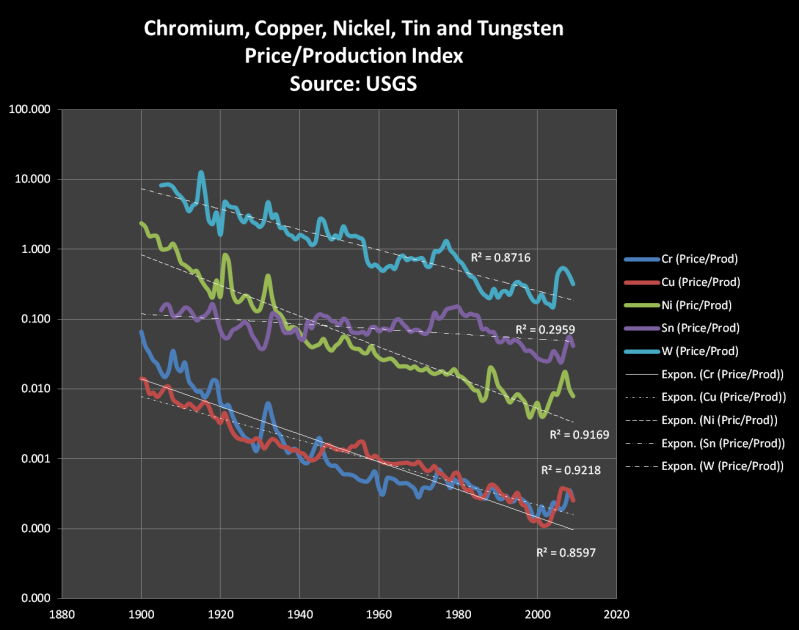
Back in 1980, the great libertarian economist, Julian Simon, and the prepetually wrong Malthusian biologist, Paul Erlich, entered into a little wager regarding population growth and resource scarcity. They decided on using the inflation-adjusted prices of five metals to decide the bet. Simon allowed Erlich to pick the five metals. If the 1990 prices were higher, Erlich would win. If they were lower, Simon would win. With the help of a fellow perpetually wrong Malthusian, John P. Holdren, Erlich selected chromium (Cr), copper (Cu), Nickel (Ni), tin (Sn) and tungsten (W). Julian Simon won the bet. _WattsUpWithThat
The article linked above proceeds to look at price and production trends for these 5 metals, in order to determine whether Julian Simon was lucky, or good.

All images via Watts Up With That!?!
Prices of the metals appear remarkably stable when adjusted for inflation. But there is more to the story than this.
Over time, production of these 5 metals continues to rise. Even more interestingly, the price to production index of the metals has declined consistently. This is an indicator of expected stability of production.
Not only are the prospects for future economical metals production quite good, but the same is true for the crude oil and liquid hydrocarbons sectors. Proved crude oil reserves continue to go up, despite sustained high production rates.

But here is the bad news for peak oilers and other doomers: Technologies which will provide substitution liquid fuels such as bitumens to liquids, gas to liquids, coal to liquids, and even biomass to liquids, etc, are developing much more quickly than most prognosticators would have though possible.
Finally, world food supply is rising step for step with world population. This is logical, since the planet Earth has an incredibly expandable capacity for biological production, which has barely been tapped to this point.

Overall, this is a fairly optimistic look at the future of planetary resources. For a more extensive look at the thinking behind economist Julian Simon's famous bet with doomer Paul Erlich, go to the free online book, The Ultimate Resource II.

There you will learn that human ingenuity is the ultimate resource which determines the scarcity or abundance of the other important resources necessary for an abundant future.

Monday, January 16, 2012

Obama a Terrible Venture Capitalist! President Backs 12 "Green Energy" Failures With $Billions of Taxpayer Dollars

CBS News counted 12 clean energy companies that are having trouble after collectively being approved for more than $6.5 billion in federal assistance. Five have filed for bankruptcy: The junk bond-rated Beacon, Evergreen Solar, SpectraWatt, AES' subsidiary Eastern Energy and Solyndra.

Others are also struggling with potential problems. Nevada Geothermal -- a home state project personally endorsed by Senate Majority Leader Harry Reid -- warns of multiple potential defaults in new SEC filings reviewed by CBS News. It was already having trouble paying the bills when it received $98.5 million in Energy Department loan guarantees.

SunPower landed a deal linked to a $1.2 billion loan guarantee last fall, after a French oil company took it over. On its last financial statement, SunPower owed more than it was worth. On its last financial statement, SunPower owed more than it was worth. SunPower's role is to design, build and initially operate and maintain the California Valley Solar Ranch Project that's the subject of the loan guarantee.

First Solar was the biggest S&P 500 loser in 2011 and its CEO was cut loose - even as taxpayers were forced to back a whopping $3 billion in company loans.

Nobody from the Energy Department would agree to an interview. Last November at a hearing on Solyndra, Energy Secretary Steven Chu strongly defended the government's attempts to bolster America's clean energy prospects. "In the coming decades, the clean energy sector is expected to grow by hundreds of billions of dollars," Chu said. "We are in a fierce global race to capture this market."

Economist Morici says even somebody as smart as Secretary Chu -- an award-winning scientist -- shouldn't be playing "venture capitalist" with tax dollars. "Tasking a Nobel Prize mathematician to make investments for the U.S. government is like asking the manager of the New York Yankees to be general in charge of America's troops in Afghanistan," Morici said. "It's that absurd." _CBS_via_MJPerry
The Obama administration is reckless and corrupt with American taxpayer's money. At the same time that Obama is throwing taxpayer dollars at his campaign supporters in the green energy sector, he is actually killing energy ventures in time-tested areas such as coal, offshore oil, Canadian oilsands pipelines, nuclear energy, and more.

It is time for Mr. Obama and his band of energy starvationist zombies to be sent on their way.

Sunday, January 15, 2012

Future of Human Species: Hybrid Plant:Animal?

The small animal in the photograph is Mesodinium chamaeleon, a ciliate that incorporates algae into itself to become a hybrid plant :: animal, capable of producing its own food.
M. chamaeleon is a ciliate – a kind of single-celled animal covered in hundreds of tiny "hairs" called cilia. It was discovered in Nivå bay in Denmark by Øjvind Moestrup of the University of Copenhagen, also in Denmark, and his team. Other specimens have since been found off the coasts of Finland and Rhode Island.

Ciliates using their hair-like cilia to motor around rapidly in water. Most get their food by eating other organisms, rather than by synthesising the nutrients themselves. This marks them as quite animal-like.

Some Mesodinium species are different, though. They engulf other microorganisms, generally algae called cryptomonads. The two then form a partnership: the algae produce sugars by photosynthesis, while the Mesodinium protects them and carries them around.

Such hybrid organisms are animals and plants at the same time. _NewScientist
Imagine green or blue-skinned humans who carry the machinery of photosynthesis with them wherever they go? Constantly fueled by glucose whenever the sun is shining or when under UV light, these humans never need to go hungry, or to carry bulky food rations with them on a trek. Their photosynthetic bio-machines could even be programmed to produce proteins, essential fats, and other nutrients.

What would happen to the human digestive apparatus, should human skin be given the function of nourishing the organism? Best not to do away with it altogether, since humans appreciate the sense of taste, and enjoy the social lubrication of eating and drinking together.

It is a simple modification, but one with enormous ramifications, should it prove easy to do on a large scale. Growing functional gills for breathing underwater is likely to be more difficult to achieve. But don't despair. Al Fin evolutionary engineers are working on the problem as we speak.

Tuesday, January 10, 2012

Unconscious Control of the Unconscious Mind

There's a wonderful experiment I heard described at a conference in Kyoto a few months ago. What the Japanese scientists did was to get their subjects to play a cooperation game, a prisoner's dilemma game, online. Subjects could choose to act generously, trust the opponent, or mistrust and default on the exchange.

Now, to one side of the computer on which subjects were playing this game, the experimenters had set up another computer with a screen-saver on it. There were two conditions. In one the screen-saver showed a little animation of two balls, one of which was helping another one over a barrier, coming up underneath it and giving it a shove-over; in the other, one of the balls was hindering another from getting over the barrier by getting in its way.

Astonishingly, the subjects of this experiment who had the cooperative animation running on the screen to one side were twice as likely to cooperate in their game with another player online, even though they didn't acknowledge that they'd noticed anything on the secondary screen. And even if they had noticed it, so what? I mean why should they copy something which is just going on a screen-saver? _Edge Nicholas Humphrey
Nicholas Humphrey is a theoretical psychologist and author, living and working in the UK. In this Edge.org piece, Humphrey draws parallels between the unconscious mental mechanisms which operate in "the placebo affect," and the unconscious mental mechanisms which influence the nature of our daily behaviour. Specifically, he is looking at how culture can mould behaviour unconsciously, and on a moment-to-moment basis.
Can cultural signals encourage people to reveal sides of their personality or faculties that they wouldn't have dared to reveal in the past? Or for that matter can culture block them? There's good reason to think this is in fact our history.

Go back 10 or 20,000 years ago. Eccentricity would not have been tolerated. Unusual intelligence would not have been tolerated. Even behaving "out of character" would not have been tolerated. People were expected to conform, and they did conform, because they picked up the cues from their environment about the right and proper—the adaptive—way to behave. In response to cultural signals people were in effect policing their own personality.

And they still are. In fact we now have plenty of experimental evidence about the operation of "sub-conscious primes", how signals from the local environment get to people without their knowing it and, by changing their character and attitudes, regulate the face they present to the world. It can be a change for the worse (at least as we'd see it today). But so too it can be a change for the better. People become, let's say, more pro-social, more generous.

...I've come round to the idea that humans have in fact evolved a full-blown self management system, with the job of managing all their psychological resources put together, so as to optimise the persona they present to the world.... Our ancestors needed to develop a system for managing the face they present to the world: how they came across to other people, when to flirt, when to hold back, when to be generous, when to be mean, when to fall in love, when to reject, when to reciprocate, when to punish, when to take the lead, when to retire, and so on. . . All these aspects had to be very carefully balanced if they were going to maximize their chances of success in the social world.

...Once we have a theoretical understanding of how all this works, can we exploit it in practical ways to change people's lives for the better? Does it offer us tools for social engineering? Just as we've discovered how to use placebo medicine to persuade people to heal themselves when they wouldn't have dared to otherwise, can we discover placebo treatments for the self—pretenses about the environment they're in that persuade people to reveal sides of their character they wouldn't have dared to reveal otherwise?

... When I think about how events in our evolutionary past still shape our lives today, I like to draw a parallel with the echoes of the Big Bang, the background microwave radiation, which can still be detected in the telescopes we send to space. Likewise, the human genome carries vibrations from the deep, deep childhood of our species, which still show up in contemporary behavior. Every one of us brings the past into the present. _Edge Nicholas Humphrey
Humphrey's dichotomy between our evolutionary heritage and our cultural heritage is reminiscent of the old "nature vs nurture" debate. Most of us understand that it is impossible to separate "nature" from "nurture," and so it is also impossible to separate "culture" from the "genetic complement" of a closely related group. The sooner psychology as a whole comprehends this basic fact, the sooner we will be able to move on to more important matters.

Saturday, January 07, 2012

More on Kahneman's Insights, from Freeman Dyson

Reflecting fifty years later on his experience in the Israeli army, Kahneman remarks in Thinking, Fast and Slow that it was not unusual in those days for young people to be given big responsibilities. The country itself was only seven years old. “All its institutions were under construction,” he says, “and someone had to build them.” He was lucky to be given this chance to share in the building of a country, and at the same time to achieve an intellectual insight into human nature. He understood that the failure of the old interview system was a special case of a general phenomenon that he called “the illusion of validity.” At this point, he says, “I had discovered my first cognitive illusion.”

Cognitive illusions are the main theme of his book. A cognitive illusion is a false belief that we intuitively accept as true. The illusion of validity is a false belief in the reliability of our own judgment. The interviewers sincerely believed that they could predict the performance of recruits after talking with them for fifteen minutes. Even after the interviewers had seen the statistical evidence that their belief was an illusion, they still could not help believing it. Kahneman confesses that he himself still experiences the illusion of validity, after fifty years of warning other people against it. He cannot escape the illusion that his own intuitive judgments are trustworthy. _Freeman Dyson
The deep trust that we all place in our own intuitive judgments is what Kahneman is trying to warn us about. But more importantly, Kahneman explains to us just why our intuitive judgments are so prone to being faulty.
At the end of his book, Kahneman asks the question: What practical benefit can we derive from an understanding of our irrational mental processes? We know that our judgments are heavily biased by inherited illusions, which helped us to survive in a snake-infested jungle but have nothing to do with logic. We also know that, even when we become aware of the bias and the illusions, the illusions do not disappear. What use is it to know that we are deluded, if the knowledge does not dispel the delusions?

Kahneman answers this question by saying that he hopes to change our behavior by changing our vocabulary. If the names that he invented for various common biases and illusions, “illusion of validity,” “availability bias,” “endowment effect,” and others that I have no space to describe in this review, become part of our everyday vocabulary, then he hopes to see the illusions lose their power to deceive us. If we use these names every day to criticize our friends’ mistaken judgments and to confess our own, then perhaps we will learn to overcome our illusions. Perhaps our children and grandchildren will grow up using the new vocabulary and will automatically correct their congenital biases when making judgments. If this miracle happens, then future generations will owe a big debt to Kahneman for giving them a clearer vision. _Freeman Dyson
And then, Freeman Dyson asks us to take Kahneman's insights, and to courageously apply them to farther fields of human endeavour. According to Dyson, Kahneman limited his research to what could be studied experimentally. But of all the broad range of life which humans experience, only a select segment can be studied in that way. Kahneman's insights are thus in need of expansion to other areas of life.
Freud and James were artists and not scientists. It is normal for artists who achieve great acclaim during their lifetimes to go into eclipse and become unfashionable after their deaths. Fifty or a hundred years later, they may enjoy a revival of their reputations, and they may then be admitted to the ranks of permanent greatness. Admirers of Freud and James may hope that the time may come when they will stand together with Kahneman as three great explorers of the human psyche, Freud and James as explorers of our deeper emotions, Kahneman as the explorer of our more humdrum cognitive processes. But that time has not yet come. Meanwhile, we must be grateful to Kahneman for giving us in this book a joyful understanding of the practical side of our personalities. _Freeman Dyson
We should be grateful to Dyson for pointing out this important fact: Human experience is far broader than that which can be studied and explained by psychological experimentation.

Just as good science must be supported and reinforced by good philosophy, so must good science be complemented by deep and time-tested insights into human nature that come from a wide range of fields outside of traditional science.

Friday, January 06, 2012

Revolutions in Learning: A Better Reinforcement Schedule?

Researchers of learning have been looking into schedules for reinforcement and learning for quite some time. Now, U. Texas scientists led by John H. Byrne have returned to the Aplysia sea slug to write a new lesson in optimal reinforcement schedules of learning.
Byrne's team deployed a computer to model 10,000 permutations of intervals between pulses to try to coordinate activation of enzymes and to maximize their interaction. The optimal protocol, it turned out, was not the usual, even-spaced one, but an irregular series of two serotonin pulses emitted 10 minutes apart, then one five minutes later, with a final spritz 30 minutes afterward. With this regimen, interaction between the two enzymes rose by 50 percent—an indication that the learning process was operating more efficiently.

So should you be studying Riemann sums every other day for two weeks and then take a month off before going back to them? Too early to say. The timing protocol Byrne found may be the slugs' adaptation to lobster claws crunching their tails. Studying integral calculus might be a bit different. But the implication of Byrne's work is that the best way to learn may not occur in simple time chunks—and that leaves a meaty set of new research questions for neuroscientists to pursue. "The dream of cognitive neuroscience is going from molecules to behavior by way of the brain," says Gary Marcus, a psychologist at New York University, and author of Guitar Zero: The New Musician and the Science of Learning. "This is a terrific step in that direction."

For their part, Byrne and company will now use these same techniques to try to optimize other aspects of the memory formation process in sea slugs. If that proves successful, they may eventually move on to humans. Motor skills would probably be the first target—throwing a baseball, doing the high jump, or helping a stroke victim to walk again. Science homework will have to wait. Researchers know more about the brain circuits in the cerebellum, involved with movement, than in the hippocampus, a locus for initiating the type of factual memories needed for organic chemistry.

Better ways to learn based on brain science would have enormous ramifications for educational practices. "It's not going to be an easy direction to follow because it means a lot of painstaking and detailed work to understand the biochemistry of learning," Byrne says. "But I think what it demonstrates is that if you have that information you may be able to make some big advancements in improving learning abilities by being in sync with the underlying molecular dynamics. Rather than taking cognitive enhancement drugs, you could have better training procedures." _SciAm

A sea slug is not a human, and yet an incredible amount of information about neural processes in sea slugs has proved applicable to higher animals, including humans.

This is how some revolutions begin: Lowly and slowly, then picking up speed and rising in general awareness and scale of application. These developments could eventually overturn the way that sclerotic and ineffective educational institutions operate -- which might just save the world.