Showing posts with label commodities. Show all posts

Wednesday, January 25, 2012

An Optimistic Look at the Future of Vital Resources

Back in 1980, the great libertarian economist, Julian Simon, and the prepetually wrong Malthusian biologist, Paul Erlich, entered into a little wager regarding population growth and resource scarcity. They decided on using the inflation-adjusted prices of five metals to decide the bet. Simon allowed Erlich to pick the five metals. If the 1990 prices were higher, Erlich would win. If they were lower, Simon would win. With the help of a fellow perpetually wrong Malthusian, John P. Holdren, Erlich selected chromium (Cr), copper (Cu), Nickel (Ni), tin (Sn) and tungsten (W). Julian Simon won the bet. _WattsUpWithThat
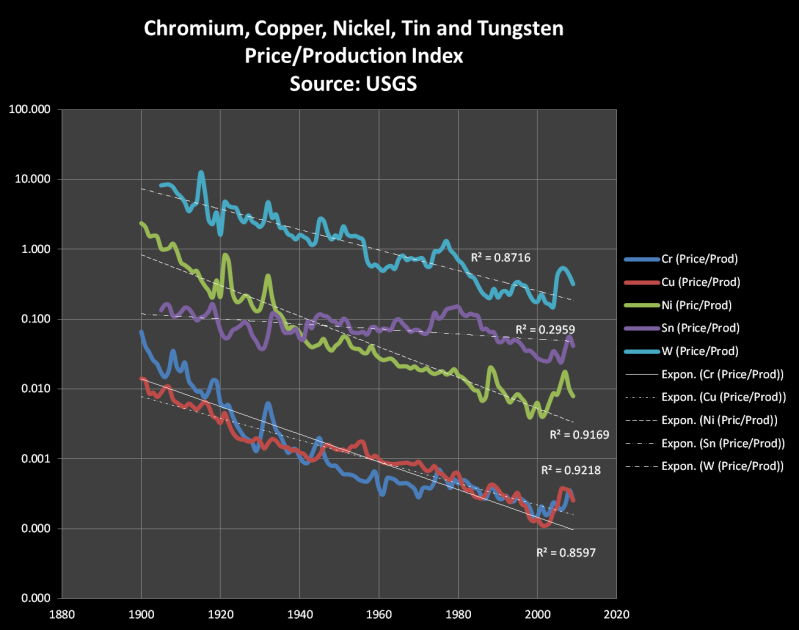
The article linked above proceeds to look at price and production trends for these 5 metals, in order to determine whether Julian Simon was lucky, or good.

All images via Watts Up With That!?!
Prices of the metals appear remarkably stable when adjusted for inflation. But there is more to the story than this.
Over time, production of these 5 metals continues to rise. Even more interestingly, the price to production index of the metals has declined consistently. This is an indicator of expected stability of production.
Not only are the prospects for future economical metals production quite good, but the same is true for the crude oil and liquid hydrocarbons sectors. Proved crude oil reserves continue to go up, despite sustained high production rates.

But here is the bad news for peak oilers and other doomers: Technologies which will provide substitution liquid fuels such as bitumens to liquids, gas to liquids, coal to liquids, and even biomass to liquids, etc, are developing much more quickly than most prognosticators would have though possible.
Finally, world food supply is rising step for step with world population. This is logical, since the planet Earth has an incredibly expandable capacity for biological production, which has barely been tapped to this point.

Overall, this is a fairly optimistic look at the future of planetary resources. For a more extensive look at the thinking behind economist Julian Simon's famous bet with doomer Paul Erlich, go to the free online book, The Ultimate Resource II.

There you will learn that human ingenuity is the ultimate resource which determines the scarcity or abundance of the other important resources necessary for an abundant future.

Sunday, March 21, 2010

Some Important Reasons Why Oil Prices Change

Over the past decade or two, oil prices have experienced a whip-saw of fluctuations. It is instructive to look at some of the underlying causes and non-causes for oil price whiplash.
In late 2008, equity and commodity prices crashed. Oil prices fell from $147 per barrel to a low of $32 per barrel in December 2009. Those who all along maintained that China and India were the cause of oil and commodity price inflation must have been embarrassed by this crash. Surely, they could no longer defend their view that China and India were the key determinant of oil and commodity price inflation.

If rapidly increasing demand from China and India was behind the explosion in oil and commodity prices, a student of economics would have had to infer that demand from China and India had crashed, or possibly supply had exploded. But this is not supported by the facts. Despite a fall in oil prices by 82% in less than four months, oil output and oil demand remained stable at 86 million barrels per day (mbd) during September-December 2008.

Similarly, the acceleration of oil prices from $71 per barrel from August 2007 to $147 per barrel in July 2008 would have made the same student think that oil demand had increased dramatically or oil supply had fallen dramatically. Neither event took place nor realistically could they have. Oil demand and supply remained stable at 86 mbd during August 2007-July 2008.

... Speculators are interested in profits from short-term changes in commodity and equity prices. Traders in oil futures could be commercial traders, non-commercial traders, or others. Non-commercial traders could include banks, hedge funds, commodity funds, pension funds, and a number of other institutions; brokers could trade for their own account.

Non-commercial trade may account for 60% to 80% of traded futures contracts. A seller of an oil futures contract does not need to be Exxon, British Petroleum, Shell, or any other oil company. A hedge fund that buys oil futures contracts would become a seller of a futures contract when it closes a position to reap gains or prevent losses from its futures contracts. In fact, futures contracts are settled in offset cash settlement and very rarely through actual delivery of commodities.

Why were oil prices stable during 1983-2000 at about $18-$20 per barrel? Does it mean that there were no speculators in the market during that time? Or similarly, why did the New York Exchange not crash during 1920-1929? Were there no speculators during that time? Speculators are always operating in the market.

...It is cheap liquidity that fuels speculation. When central banks generously provide very cheap liquidity, speculation is fired up. The speed at which equity, commodity, and asset prices rise would depend on the speculative euphoria and the real economic activity. Buoyant real activity would accelerate the speed at which speculative prices rise. Nonetheless, a drop in real activity would not necessarily preclude a rapid rise in prices when interest rates are very low and liquidity abundant. For instance, oil prices rose from $32 per barrel in December 2008 to $82 per barrel in March 2010 even though oil demand declined from 86 mbd in December 2008 to 85 mbd in March 2010. In 2009, major banks posted large profits from trading in commodities and equities in spite of a sluggish economy and rising unemployment.

...Commodity markets rapidly transmit the inflationary effects of US Fed and other major reserve currency central banks monetary policies. Commodity prices are very sensitive to interest rates and availability of liquidity through borrowing. Cheap money policies have operated through a number of channels, including credit channel, exchange rate channel, and commodity channel. The commodity markets channel operates faster in comparison to other channels with instantaneous impact on consumer prices. For instance, while US banks are at present awash with $1.175 trillion in excess reserves, which they could not lend profitably and with reduced risk, futures markets have been on a speculative rise as illustrated by large rebounds in gold, oil, food, and many other commodity prices.

...Who is in a position to determine whether oil prices move to $100 per barrel, $147 per barrel, or even higher? It is not the Organization of the Petroleum Exporting Countries, China or India. It is not even the speculators. Speculators are simply microstructures that are risk-averse and seek to profit from opportunities for gains; they were not able to prevent a sharp decline in oil prices from $41 per barrel in 1981 to $8 per barrel in 1986, nor were they able to push oil prices beyond $18-$22 per barrel during 1985-2000.

...Fictitious money creation by reserve currency central banks was conducive to high oil and commodity price inflation. Since the US Fed could not push oil output above 85 mbd nor could it prevent a sharp drop in sugar output, its fictitious money creation has amounted to a real redistribution of purchasing power in favor of borrowers and speculators and imposed a heavy tax on workers, pensioners, and other fixed-income groups - and a cut in real incomes for millions of consumers around the world. By paying threefold to fourfold more for basic commodities, consumers are cutting dramatically their real consumption of these goods and at the same are being taxed directly through commodity price inflation by central banks.

__ATimes


The authors of the above article appear to believe that central banks can cause the world economy to become locked in a continuous spiral of oil and commodity price inflation. But we saw what happened in late 2008 and early 2009, and it was not pretty.

Today's oil prices -- hugely influenced by a weak US dollar -- are toward the high end of the historical scale. That means that very little price inflation would be required to produce a dramatic demand destruction and deflationary spiral.

The apparent close connection between quasi-governmental central bankers and big investment banking houses suggests that the big financial interests of the western world are in the process of picking the bones of the established economies. They have discovered some of their limits from the circumstances of the current world recession. But that will not stop them from continuing to probe for profitable lodes of salvageable gold.

It is important to understand the cynicism of those who have clawed their way to power over the giant institutions that have so much influence over our lives. That way, when we go about doing the things that we must to make those institutions unnecessary, we will not have to feel bad about their downfall.

Previously posted at abu al-fin and Al Fin Energy