Friday, August 19, 2011

With This Kind of Heat You Can Kill Peak Oil

With plentiful process heat provided at temperatures between 700 C and 950 C, a person could kill peak oil and have plenty of energy left to power industry and a broad spectrum of industrial processes.   Specifically, one could:
  1. Unlock the trillions of barrels oil equivalent in oil sands (PDF)
  2. Unlock the trillions of barrels oil equivalent in coal to liquids and gas to liquids (PDF)
  3. Unlock the trillions of barrels oil equivalent in shale oil kerogens 
  4. Provide abundant industrial process heat for production of fertilisers, refining fuels, making plastics, etc 
  5. Split CO2 into CO to use as a hydrogen carrier 
  6. Overturn conventional fears of EROEI and Peak Oil 
Those things, and many more, will be accomplished by next generation gas-cooled high temperature nuclear reactors. Helium gas coolant will run gas turbine generators at high temperatures, which provides electrical power at higher efficiencies than older steam cycle generation systems. And as mentioned above, the higher temperature process heat will find a wide range of practical uses in industrial processes and energy production.

Conventional fears about EROEI and peak oil will be overturned since the energy used to produce hydrocarbon fuels, fertilisers, plastics, and other products of industry and energy, will come from the high temperature heat effluent of nuclear reactions -- of which there is no conceivable near term shortage.  Unless political lefty-Luddite dieoff.orgy forces of faux environmentalism intrude even further than at present.  In that case, all bets are off, and the leftist inspired great human dieoff is put on the table by government planners.

But that would be political peak oil and political energy starvation.  Which is yet another reason why choosing your political leaders wisely can be a matter of life or death.

Thursday, August 18, 2011

Peter Thiel, SeaSteading's Financial Backer, Doesn't Like Boats

SeaDragon

The website "Details.com" provides an interesting profile of the billionaire backer of the Seasteading Institute, Peter Thiel. One of the things you learn is that Thiel doesn't particularly like boats, and doesn't plan to be an early adapter of seasteading. Another thing you will learn is that Thiel is something of a maverick provocateur.
If the seasteading movement goes forward as planned, Thiel won't be one of its early citizens. For one thing, he's not overly fond of boats, although maybe, as Friedman says, "he just needs to be on a large enough structure." Thiel characterizes his interest as "theoretical." But whether Thiel himself heads offshore or not, there's a whole lot of passion underlying that theoretical interest. Thiel put forth his views on the subject in a 2009 essay for the Cato Institute, in which he flatly declared, "I no longer believe that freedom and democracy are compatible." He went on: "The great task for libertarians is to find an escape from politics in all its forms," with the critical question being "how to escape not via politics but beyond it. Because there are no truly free places left in our world, I suspect that the mode for escape must involve some sort of new and hitherto untried process that leads us to some undiscovered country."

Until a libertarian colony can be established in outer space—Thiel is bullish on that idea, too, though he thinks the technology needs at least a half-century to develop—seasteading will have to suffice. "[It's] not just possible, or desirable," he said in an address at the 2009 Seasteading Institute Conference, "but actually necessary." _Details

Also check out this Cato-at-Liberty article on seasteads from the perspective of tax havens. It includes a 9 minute video on the economic benefits of tax havens.

This short article on Peter Thiel and seasteading at The Week.com, includes a number of criticisms of seasteading from a small number of web personalities.

The near-term vision of seasteading as promoted by The Seasteading Institute is not particularly inspiring. Front man Patri Friedman does alright in public speaking, media appearances, and writing articles. But he does not have the type of maritime heavy industry background that would inspire confidence in truly serious investors.

Seasteading is desperately in need of a "killer app," and it is not clear that offshore gambling, banking, and tax havens will be good enough -- particularly if the legal question of sovereignty is not settled.

In a global boom economy, seasteading might have better prospects, and a lot more millionaire and billionaire investors. But there is a need for more "heavy hitters" with backgrounds in large marine structures and financing, and in the various offshore industries which might bring quick profits to such a speculative venture.

The challenge of building a robust seastead able to stand up to anything the ocean might throw at it, is not as great a challenge as building a robust space elevator to geosynchronous orbit. But it is still a significant challenge.

The challenge of raising new generations of young people with practical real world competencies, plus a sense of adventure, is likewise a significant challenge -- given the state of today's perpetual adolescent incompetents, psychological neotenates, and academic lobotomates. But challenges tend to bring out the greatness in innovators.

Stay tuned.

Tuesday, August 09, 2011

Mega-Super WiFi 802.22 Can Cover 12,000 Square Miles

To put it in a nutshell, 802.22 was designed to run on a totally new spectrum which was made available when analog TVs were outlawed some years back in the US. For those who prefer more solid scientific figures, the 802.22 spectrum will work in ranges from 54MHz to 698MHz, where such frequencies are the perfect vehicle for long distance transmissions.

Imagine sending out 22 Mbps of data within a 62 mile radius from a sole base station – that would certainly bring Wi-Fi connectivity to even the most rural areas around the country. _Ubergizmo
IEEE has created a new 802.22 WiFi standard to take advantage of the FCC "Super WiFi" classification.
IEEE, the world’s largest professional association advancing technology for humanity, today announced that it has published the IEEE 802.22TM standard. IEEE 802.22 systems will provide broadband access to wide regional areas around the world and bring reliable and secure high-speed communications to under-served and un-served communities.


This new standard for Wireless Regional Area Networks (WRANs) takes advantage of the favorable transmission characteristics of the VHF and UHF TV bands to provide broadband wireless access over a large area up to 100 km from the transmitter. Each WRAN will deliver up to 22 Mbps per channel without interfering with reception of existing TV broadcast stations, using the so-called white spaces between the occupied TV channels. This technology is especially useful for serving less densely populated areas, such as rural areas, and developing countries where most vacant TV channels can be found.

IEEE 802.22 incorporates advanced cognitive radio capabilities including dynamic spectrum access, incumbent database access, accurate geolocation techniques, spectrum sensing, regulatory domain dependent policies, spectrum etiquette, and coexistence for optimal use of the available spectrum.

The IEEE 802.22 Working Group started its work following the Notice of Inquiry issued by the United States Federal Communications Commission on unlicensed operation in the TV broadcast bands. _IEEE Press Release via Tekgoblin
More on Super WiFi:
Super Wi-Fi is inching closer to reality, and now the IEEE, the standards organization responsible for all things Wi-Fi, has published the IEEE 802.22standard.

This new wireless networking standard promises speeds up to 22Mbps to devices as far as 100-kilometers (roughly 62-miles) away from the nearest transmitter. This new band of Wi-Fi on steroids comes through the patch of "white space" frequencies that were previously used to analog television broadcasts.

There’s no word on when and which regions of the United States will be the first to get in on this super Wi-Fi. Houston is currently the only access point for a white space Wi-Fi, which comes courtesy of Rice University researchers. Super Wi-Fi has been slow in coming since the FCC originally approved it back in September 2010. _PCWorld
Similar technologies can create dynamic wide range data networks on the open seas, to improve safety and expand exchange for large fleets of working seasteads. New colonies built across the Arctic and Antarctic could likewise use this type of wide range networking, to coordinate activities, weather warnings, etc.


Wednesday, August 03, 2011

Las Vegas Hot and Dry for Black Hat Conference

The Black Hat security conference opens in Las Vegas, Nevada, today to hot, dry weather, and a very full schedule.
Security researchers will demonstrate new hacking techniques that probe networking devices, exploit holes in common database management systems and target vulnerabilities deep inside various operating systems. Other experts will reveal research into the destructive power of new, more sophisticated malware strains designed to remain virtually undetectable long after they penetrate target systems.

...The focus will turn to weaknesses in cloud architecture when two members of WhiteHat Security Inc.'s Threat Research Center, Matt Johansen and Kyle Osborn, show off serious holes in Google Chromebooks, notebook computers that run the Google Chrome OS. Users of these new devices primarily use the Chrome browser to navigate the operating system and access email, files and other documents on the Web.

In a Black Hat webinar last month, Johansen said the Chromebook platform is open to Web browser attack techniques. It uses a browser-extension trust model, Johansen said, and those extensions act like Web applications, which can be attacked using the same techniques that cybercriminals have been using for years. _SearchSecurity
Meanwhile, the "biggest-ever" series of cyber attacks has been revealed in a McAfee report. Signs point to China (or perhaps Russia) as the origin of the cyber mischief.
Security experts have discovered the biggest series of cyber attacks to date, involving the infiltration of the networks of 72 organizations including the United Nations, governments and companies around the world.

Security company McAfee, which uncovered the intrusions, said it believed there was one “state actor” behind the attacks but declined to name it, though one security expert who has been briefed on the hacking said the evidence points to China.

The long list of victims in the five-year campaign include the governments of the United States, Taiwan, India, South Korea, Vietnam and Canada; the Association of Southeast Asian Nations (ASEAN); the International Olympic Committee (IOC); the World Anti-Doping Agency; and an array of companies, from defense contractors to high-tech enterprises.

In the case of the United Nations, the hackers broke into the computer system of the UN Secretariat in Geneva in 2008, hid there unnoticed for nearly two years, and quietly combed through reams of secret data, according to McAfee.

“Even we were surprised by the enormous diversity of the victim organizations and were taken aback by the audacity of the perpetrators,” McAfee’s vice president of threat research, Dmitri Alperovitch, wrote in a 14-page report released on Wednesday.

“What is happening to all this data … is still largely an open question. However, if even a fraction of it is used to build better competing products or beat a competitor at a key negotiation (due to having stolen the other team’s playbook), the loss represents a massive economic threat.”

McAfee learned of the extent of the hacking campaign in March this year, when its researchers discovered logs of the attacks while reviewing the contents of a “command and control” server that they had discovered in 2009 as part of an investigation into security breaches at defense companies.

It dubbed the attacks “Operation Shady RAT” and said the earliest breaches date back to mid-2006, though there might have been other intrusions as yet undetected. (RAT stands for “remote access tool,” a type of software that hackers and security experts use to access computer networks from afar).

Some of the attacks lasted just a month, but the longest — on the Olympic Committee of an unidentified Asian nation — went on and off for 28 months, according to McAfee.

“Companies and government agencies are getting raped and pillaged every day. They are losing economic advantage and national secrets to unscrupulous competitors,” Alperovitch told Reuters.

“This is the biggest transfer of wealth in terms of intellectual property in history,” he said. “The scale at which this is occurring is really, really frightening.” _FinancialPost
Given its shady history, China is the most likey perpetrator, although Russia cannot be ruled out entirely. The cyber and crypto arms races are ongoing and unlikely to end until humans stop using advanced computing, communications, and codes.

Thursday, July 14, 2011

Who Can Defend Planet Earth from the Real Threats?

Power Point Slide Presentation via Brian Wang

The US is dismantling its space program, piece by piece, and neither Europe nor Russia can afford their ambitious space goals. Only China appears to be in a position to pursue the vast opportunities, riches, and challenges of space travel, exploration, colonisation, and . . . . yes, militarisation. It is the high ground, after all.

Unless humans create space-based defenses against errant asteroids, comets, and other dangers from extraterrestrial space, the planet Earth and its precious biosphere will remain defenseless against the most serious threats it will likely face.

Brian Wang takes a look at the problem in a recent posting, Defending Planet Earth from Space Asteroids.
4 approaches depending on circumstances

* Civil defense (evacuation, sheltering, first aid, etc.
- Up to 50 meter in diameter?

* Slow Push-Pull (tug, solar heating, albedo change, gravity tractor, et al.)
- Needs decades to operate (plus time to build, etc.)
- Max size 300-600 m diameter
- Gravity tractor closest to ready and least dependent on properties of NEO

* Kinetic Impacts (Super Deep Impact)
- sensitive to porosity of top meters to tens of meters
- momentum transfer efficiency not known
- much wider range of applicability (max size 1 to 1.5 km, shorter warning for small ones)

*Nuclear blast
- standoff blast best
- works up to 10 km and relatively short warning


What Next

* Don Quixote-like mission
- a rendezvous spacecraft at a small NEO followed by a large impactor
- biggest gain in knowledge directly related to mitigation
- Guess $1.5G; Good for international collaboration

* Gravity tractor demonstration
- fewer unknowns other than engineering
- second priority

* Apophis a possible target but any small NEO will do
- Can’t predict which might need to be used first
- Small NEO is by far the most likely
- Warning time very uncertain but short warnings are likely at ~100m diameter or less _NBF

More at link above, and at Planetary Defense and NEO Exploration PPT

Only humans with advanced science and technology can defend their planet from space threats such as comet and asteroid collision. But while the advanced western world governments are dominated by faux environmentalists and beseiged by the twin destructors of debt and demographic decline, science and technology are skewed toward dysfunctional phantom fears such as carbon hysteria, overpopulation doom, etc.

Yet another extremely dangerous societal dysfunction in the west is the ongoing "war against boys" led by highly placed feminsts in academia, journalism, think tanks, and government. It is from among the boys -- including some with Aspergers, dyslexia, and ADD -- that the bulk of high achieving scientists and technologists will inevitably be found. The war against boys is a war against science and technology, and a war against the future of the planet and the human race.

Human societies in general are going the wrong direction, heading toward an Idiocracy. It may be up to isolated groups of humans, building alliances among themselves, to preserve and extend the art of human and planetary survival via the advancement of true science and beneficial / protective technologies.

Tuesday, July 05, 2011

Lori Gottlieb and the Collapse of the American Empire

The message we send kids with all the choices we give them is that they are entitled to a perfect life—that, as Dan Kindlon, the psychologist from Harvard, puts it, “if they ever feel a twinge of non-euphoria, there should be another option.” Mogel puts it even more bluntly: what parents are creating with all this choice are anxious and entitled kids whom she describes as “handicapped royalty.” _Lori Gottlieb

Pity meek and mild Lori Gottlieb, an intern in family counseling who has made some interesting observations in the course of her work. Gottlieb discussed her observations in a recent piece in the Atlantic. The piece has raised a firestorm of online debate, snark, and condemnation, almost entirely undeserved. The fault in Gottlieb's piece lies not in what she says, but in what she leaves out -- what these disturbing findings imply for the future of the American empire.
...Here I was, seeing the flesh-and-blood results of the kind of parenting that my peers and I were trying to practice with our own kids, precisely so that they wouldn’t end up on a therapist’s couch one day. We were running ourselves ragged in a herculean effort to do right by our kids—yet what seemed like grown-up versions of them were sitting in our offices, saying they felt empty, confused, and anxious. Back in graduate school, the clinical focus had always been on how the lack of parental attunement affects the child. It never occurred to any of us to ask, what if the parents are too attuned? What happens to those kids?

...Dan Kindlon, a child psychologist and lecturer at Harvard, warns against what he calls our “discomfort with discomfort” in his book Too Much of a Good Thing: Raising Children of Character in an Indulgent Age. If kids can’t experience painful feelings, Kindlon told me when I called him not long ago, they won’t develop “psychological immunity.”

“It’s like the way our body’s immune system develops,” he explained. “You have to be exposed to pathogens, or your body won’t know how to respond to an attack. Kids also need exposure to discomfort, failure, and struggle...

...Wendy Mogel is a clinical psychologist in Los Angeles who, after the publication of her book The Blessing of a Skinned Knee a decade ago, became an adviser to schools all over the country. When I talked to her this spring, she said that over the past few years, college deans have reported receiving growing numbers of incoming freshmen they’ve dubbed “teacups” because they’re so fragile that they break down anytime things don’t go their way. “Well-intentioned parents have been metabolizing their anxiety for them their entire childhoods,” Mogel said of these kids, “so they don’t know how to deal with it when they grow up.”

...A few months ago, I called up Jean Twenge, a co-author of The Narcissism Epidemic and professor of psychology at San Diego State University, who has written extensively about narcissism and self-esteem. She told me she wasn’t surprised that some of my patients reported having very happy childhoods but felt dissatisfied and lost as adults. When ego-boosting parents exclaim “Great job!” not just the first time a young child puts on his shoes but every single morning he does this, the child learns to feel that everything he does is special. Likewise, if the kid participates in activities where he gets stickers for “good tries,” he never gets negative feedback on his performance.

...This same teacher—who asked not to be identified, for fear of losing her job—says she sees many parents who think they’re setting limits, when actually, they’re just being wishy-washy. “A kid will say, ‘Can we get ice cream on the way home?’ And the parent will say, ‘No, it’s not our day. Ice-cream day is Friday.’ Then the child will push and negotiate, and the parent, who probably thinks negotiating is ‘honoring her child’s opinion,’ will say, ‘Fine, we’ll get ice cream today, but don’t ask me tomorrow, because the answer is no!’” The teacher laughed. “Every year, parents come to me and say, ‘Why won’t my child listen to me? Why won’t she take no for an answer?’ And I say, ‘Your child won’t take no for an answer, because the answer is never no!’”

... _theAtlantic
And so on... An interesting glimpse into the modern state of child-raising in the US from someone on the front lines of family therapy.

If Americans truly are raising generations of fragile, entitled children, who is going to do the hard work that needs to be done? As long as the US economy was doing well, America could import its hard workers and many of its hard thinkers, so as to keep the wheels of commerce and invention moving along. But with the rapid emergence of crisis levels of debt and demography, the US economy may not be able to import so much of its needed human capital -- to compensate for the disastrous failures of its parents and educational system.

Children need to learn practical competence in a wide range of skills. They need to learn to focus on a difficult task, and learn to work hard at it until it is done. Children must not be age-segregated in prison schools for so many of their formative years, kept away from any responsibility or opportunity to explore the real world.

The Roman Empire collapsed over a few centuries for many of the reasons the American empire is threatened: debt, demography, social problems that were swept under the rug, entitled and abusive ruling classes, etc.

American parents have only one or two children, on average, and far too many of them are being raised as "trophy children," pampered perpetually childish pets rather than skilled, competent, and responsible proto-adults. This failure to reproduce -- and failure to competently raise the meagre progeny which they do produce -- is what truly threatens the collapse of the American Experiment (not actually an empire in the Roman sense at all).

Gottlieb was actually rather tentative and modest in her conclusions -- not taking them as far as she perhaps should have. Yet she was castigated by the "pampering nannies" of modern academia, journalism, and the blogosphere. The dysfunction can probably not be reversed before catastrophe ensues, at least not in the many strongholds of the destructive philosophy.

It is up to parents who wish to raise competent and functional children to structure an environment around the child which facilitates the acquisition of skills and an ongoing successful adaptation to adult world responsibilities.

Monday, July 04, 2011

Solar Cycles Stalling: Ice Age On Its Way?


Average temperatures in Britain could fall by two degrees centigrade, according to the study led by Mike Lockwood, professor of space environment physics at Reading University, because of a drop in the amount of sunspot activity. _DailyMail
Little Ice Age Plunging In?

The Earth's climate is chaotic by nature, and given to drastic changes and shifts as a matter of course. The many overlapping natural cycles which contribute to global climate have been largely ignored by climate scientists -- until now.
Professor Lockwood's findings could mean the average winter temperature could drop below 2.5C, compared to the average British winter now of 5C, the newspaper reported.

In June, three different studies all concluded that sunspot activity looks set to decline over the next 10 years.

Experts said the next upswing in sunspot activity, which follows an 11-year cycle, will not be as strong as normal - or might not even happen at all.
The findings were presented at a meeting of the American Astronomical Society's solar physics division.

They said a decrease in global warming might result in the years after 2020, the approximate time when sunspots are expected to disappear for years, maybe even decades. _DailyMail

Meanwhile, climate scientists are just now beginning to admit the importance of the urban heat island effect, which has biased global temperature records upward -- contributing to the carbon hysteria which has sustained the orthodoxy of catastrophic anthropogenic global warming, and helped drive the bandwagon and steamroller of the great climate panic of the late 20th and early 21st centuries.

More honest scientists are likewise admitting that extreme weather events have nothing to do with atmospheric carbon dioxide levels.

You Mustn't Believe the Lies that Green Zealots Tell. Not only about nuclear power, but about climate change, resource depletion, overpopulation, etc.

Government meddling in climate and energy will be the death of us all. It is time to stamp out government meddling, before government meddling stamps us out!

Friday, July 01, 2011

A Biological World: Sustainable Materials and Fuels

GCC

Global industry is looking for alternatives to fossil fuels, as feedstocks for the production of fuels, plastics, high value chemicals, lubricants, and other materials. The planet Earth is highly prolific in its biological output -- and it could be far more biologically prolific, given just a little help.

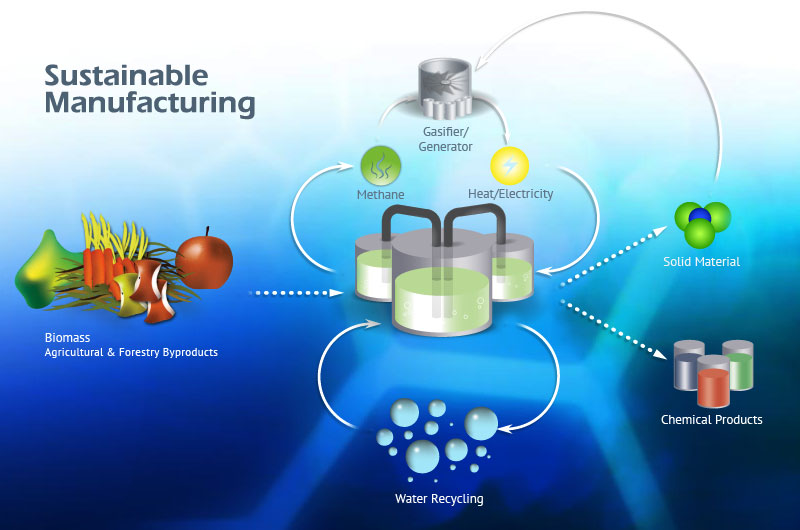
The image above depicts the scheme of Montana startup Blue Marble Biomaterials, which aims to ride a $multimillion grant from the US Advanced Manufacturing Program to successful bio-manufacturing.
The company is implementing novel recycling systems to eliminate waste and reduce cost: a photo-bioreactor containing algae purifies wastewater and waste gas from the fermentation system and their solid waste is dried and pelletized for use in wood-burning furnaces and stoves. The company has future plans to power its facilities using its own waste gas and pelletized solid waste in already on-site gasifiers.

Blue Marble Energy’s proprietary AGATE (Acid, Gas and Ammonia Targeted Extraction) system uses different bacterial consortia (“cassettes”) in an anaerobic fermentation process to produce carboxylic acids, esters, mercaptains / thiols, and terpenes. The system is feedstock flexible; for the Missoula plant, Blue Marble is using waste coffee grounds and spent grain from a major brewer, said Kelly Ogilvie, Blue Marble’s CEO.

(Blue Marble uses a supercritical fluid extraction process to remove the remaining lipids from the coffee grounds.)

The feedstock flexibility can manifest as price stability for Blue Marble’s chemical customers, Ogilvie noted. For example, the company has a stable price on the spent grain from the brewer; a waste product which otherwise would end up in landfills (i.e., the amounts above that which could economically be used for cattle feed, the other major disposal pathway for spent grain).

If we have fixed feedstock [such as the waste spent grain], we have price stability. We can hedge off the future price volatility of petroleum. Price protection is a huge issue right now.

—Kelly Ogilvie
_GCC
Blue Marble had better have its act together, because government grants run out very quickly -- no matter how well connected company founders may be to government administrators. Bio-manufacture of this range of materials, using these new technologies, is risky and cutting edge.

As long as petroleum prices remain relatively high, crafty uses of biomass and bio-products as substitutes for petroleum can make a profit. But to build a large-scale infrastructure of bio-manufacture and bio-refining, investors and participants will want to be sure the bio-approach can withstand temporary nose-dives of oil prices, such as occurred in 2008-2009 and multiple times throughout the 1900s.

Sunday, June 26, 2011

Chinese Cargo Cult Mimicry: If We Build It Will They Come?

China is building a replica Alpine village in a grimy industrial city.

It hopes the chalets in the southern city of Huizhou will be sought after by homesick Europeans.

The village will be a £5.7billion copy of Hallstatt in Austria, complete with artificial lake. Posing as tourists, the Chinese have been photographing every building there for three years. _DailyMail
Hallstatt, Austria on Lake Hallstatt

Chinese developers have built other duplicate towns, based upon villages in the UK. Now a Chinese developer has gone to extraordinary lengths to mimic an Austrian mountain village, down to the boards on building exteriors. Something tells me that the Guangdong version of Hallstatt will not provide that same fresh, brisk, clean feeling as the original.
...at the Chinese site, in the city of Huizhou about 100 miles north of the border with Hong Kong, there is little to indicate that the copycat version will ever approximate the beauty of the original.

A few low-rise buildings are in the early stages of construction, their frames covered with bamboo scaffolding and green mesh. Cranes and trucks moved around the area Friday dodging workers carrying steel construction elements.

Though the area is hilly, there was not an alpine peak in sight and the waters of a nearby lake - apparently the faux Lake Hallstatt to be - were green and murky. Instead of mirroring majestic alpine mountaintops, several dead fish floated on the surface. _DailyMail
The Chinese would do better to try to build a cleaner China, where people will want to go to understand both contemporary and historical China. Mimicking ancient European villages projects a feeling of desperate cluelessness and naivete.

First, build a better China, then if you want to build European village replicas, at least the air and water will be clean.

Tuesday, June 21, 2011

D-Dalus: A Possible Revolution in Flight from Austria

At the heart of D-DALUS is a revolutionary propulsion system containing a number of patented inventions, including a friction free bearing at the points of high G force, and a system that keeps propulsion in dynamic equilibrium, thereby allowing the guidance system to quickly restore stability in flight.

The propulsion consists of 4 sets of contra-rotating disks, each set driven at the same rpm by a conventional aero-engine. The disks are surrounded by blades whose angle of attack can be altered by off-setting the axis of the rotating disks. As each blade can be given a different angle of attack, the resulting main thrust can be in any required direction in 360° around any axis. This allows the craft to launch vertically, remain in a fixed position in the air, travel in any direction, rotate in any direction, and thrust upwards thereby ‘gluing down’ on landing. _D-Dalus Detail
Austrian research company IAT21 has presented a new type of aircraft at the Paris Air Show which has the potential to become aviation's first disruptive technology since the jet engine.

The D-Dalus (a play on Daedalus from Greek mythology) is neither fixed wing or rotor craft and uses four, mechanically-linked, contra-rotating cylindrical turbines, each running at the same 2200 rpm, for its propulsion.

The key to the D-Dalus' extreme maneuverability is the facility to alter the angle of the blades (using servos) to vector the forces, meaning that the thrust can be delivered in your choice of 360 degrees around any of the three axes. Hence D-Dalus can launch vertically, hover perfectly still and move in any direction, and that's just the start of the story. _Gizmag_via_NBF
This propulsion system may eventually scale from the microscopic to the size of large freight haulers. I suspect it will be pursued initially as a spy and surveillance platform, and as an insertion and extraction method for special ops teams. Also as remotely-operated stealthy substitutes for attack helicopters such as the Apache. Eventually, it may provide the platform for flying cars and flying boats, among other consumer and adventure toys.
The most obvious and immediate application for D-Dalus is as a little flying spy robot that can fly in doors and windows and snoop around indoors. Larger versions would be perfect for search and rescue missions, and the designers even think that in the long term, vehicles based on this technology might be what you use to commute to work. That's right — flying cars! _Dvice

I suspect that these toys will prove quite expensive to buy, operate, and maintain, but I would like to be proven wrong about that. At this point, they are at the prototype stage, and may not become reliable enough for even military use for quite some time.

What Does it Mean for Africa to Grow at 4.9% per Year?

Africa boasts an abundance of riches: 10 percent of the world’s reserves of oil, 40 percent of its gold, and 80 to 90 percent of the chromium and the platinum metal group. Those are just the known reserves; no doubt more lies undiscovered. _MQ
Global Map of Nations by per cent Living Under $1.25 per day
McKinsey Quarterly has published a fascinating look at recent economic growth in the continent of Africa (h/t Brian Wang). According to the report, real GDP growth over the continent averaged 4.9% per year between the years 2000 and 2008. This was twice Africa's growth rate over the decades of the 1980s and 1990s. The report goes on to discuss the many issues leading to such growth, and other factors that will be involved in future African growth. From McKinsey:
Africa’s collective GDP, at $1.6 trillion in 2008, is now roughly equal to Brazil’s or Russia’s, and the continent is among the world’s most rapidly growing economic regions. This acceleration is a sign of hard-earned progress and promise.

While Africa’s increased economic momentum is widely recognized, its sources and likely staying power are less understood. Soaring prices for oil, minerals, and other commodities have helped lift GDP since 2000. Forthcoming research from the McKinsey Global Institute (MGI) shows that resources accounted for only about a third of the newfound growth.1 The rest resulted from internal structural changes that have spurred the broader domestic economy. Wars, natural disasters, or poor government policies could halt or even reverse these gains in any individual country. But in the long term, internal and external trends indicate that Africa’s economic prospects are strong.

...Natural resources, and the related government spending they financed, generated just 32 percent of Africa’s GDP growth from 2000 through 2008.2 The remaining two-thirds came from other sectors, including wholesale and retail, transportation, telecommunications, and manufacturing (Exhibit 1). Economic growth accelerated across the continent, in 27 of its 30 largest economies. Indeed, countries with and without significant resource exports had similar GDP growth rates.

...To start, several African countries halted their deadly hostilities, creating the political stability necessary to restart economic growth. Next, Africa’s economies grew healthier as governments reduced the average inflation rate from 22 percent in the 1990s to 8 percent after 2000. They trimmed their foreign debt by one-quarter and shrunk their budget deficits by two-thirds.

Finally, African governments increasingly adopted policies to energize markets. They privatized state-owned enterprises, increased the openness of trade, lowered corporate taxes, strengthened regulatory and legal systems, and provided critical physical and social infrastructure. Nigeria privatized more than 116 enterprises between 1999 and 2006, for example, and Morocco and Egypt struck free-trade agreements with major export partners.

...The continent’s four most advanced economies—Egypt, Morocco, South Africa, and Tunisia—are already broadly diversified. Manufacturing and services together total 83 percent of their combined GDP. Domestic services, such as construction, banking, telecom, and retailing, have accounted for more than 70 percent of their growth since 2000. They are among the continent’s richest economies and have the least volatile GDP growth. With all the necessary ingredients for further expansion, they stand to benefit greatly from increasing ties to the global economy.

Domestic consumption is the largest contributor to growth in these countries. Their cities added more than ten million people in the last decade, real consumer spending has grown by 3 to 5 percent annually since 2000, and 90 percent of all house-holds have some discretionary income. As a result, consumer-facing sectors such as retailing, banking, and telecom have grown rapidly. Urbanization has also prompted a construction boom that created 20 to 40 percent of all jobs over the past decade.

...If recent trends continue, Africa will play an increasingly important role in the global economy. By 2040, it will be home to one in five of the planet’s young people, and the size of its labor force will top China’s. Africa has almost 60 percent of the world’s uncultivated arable land and a large share of the natural resources. Its consumer-facing sectors are growing two to three times faster than those in the OECD7 countries. And the rate of return on foreign investment is higher in Africa than in any other developing region. Global executives and investors cannot afford to ignore this. A strategy for Africa must be part of their long-term planning. _MQ


The report excerpted and linked above is quite optimistic toward the economic prospects for Africa over the next 3 decades. Al Fin economic and social forecasters do not take quite the sanguine view as those of the McKinsey Institute.

As seen in the map at the top of this entry, Africa is quite diverse in terms of economic conditions. It is an act of false parsimony to consider the entire continent as one unit, economically. Instead, one should look at SubSaharan Africa separate from North Africa, economically and socially. Further, one should subdivide SubSaharan Africa into tropical and temperate regions, when considering investments and partnerships. McKinsey failed to stratify African nations other than by "economic diversification" and "exports per capita." Useful, but not sufficient. It is difficult to draw useful conclusions when data is so badly conflated.

The time period selected for extrapolating may not be representative of what to expect from a future Africa. The ongoing instability in Egypt and Libya, for example, suggest that the chronic instability of most of tribal Africa may be spreading into nations where tribal and religious instability had been temporarily suppressed by strong political regimes of long duration.

Urbanisation may bolster GDP growth numbers temporarily, for example, due to the more quantified economic nature of more modern city living vs. quasi-ancient rural life styles. Yet there are limits to how large stable cities can grow under certain demographic conditions. Many of Africa's cities are already pressing those limits.

Modern high tech infrastructures -- such as those which allow more advanced nations to enjoy the fruits of modern trade and sci-tech development -- are dependent upon an infrastructure of human capital which is capable of maintaining and improving the underlying technological infrastructure. In the absence of capable maintenance, repair, and construction, societal infrastructure tends to collapse at the most inopportune times.

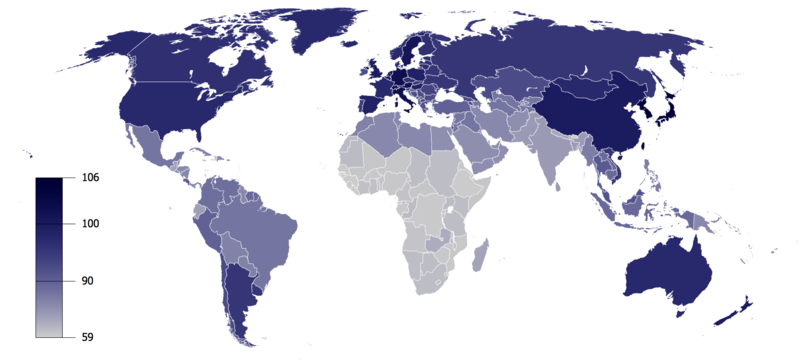
Here is the blunt truth, which Political Correctness tries to obscure: Infrastructures to support widespread modern affluent lifestyles require a high tech infrastructure which can only be maintained by populations with average IQs close to 90 or above. The only exception is if the nation hosts a "market dominant minority" of higher IQ persons to maintain markets and infrastructures -- such as the Chinese in Malaysia or Indonesia, or the shrinking population of high-IQ minorities in South Africa.

For some countries of North Africa, the average population IQs are near 85. But for most SubSaharan African nations, average population IQs are well below 80. The reasons for such low average IQs are debatable, but the blunt facts are clear and stand in the way of large scale indigenous economic development across many chronically underdeveloped parts of the world.
Global IQ Map by Nation

For Africa to grow sustainably, it will need to attract leadership and energy from the outside -- and keep it there rather than driving it out, as was done in Zimbabwe, Kenya, Uganda, etc. An expansion of what it means to be "African" is mandatory -- but it can only be made to last in an Africa of greatly expanded opportunity and radically reduced corruption and populist demagoguery.

Al Fin futurists suspect that perpetually ambitious and corrupt African tribal leaders and strongmen will only accept the changes that are needed, under the sanction of a non-human "superior being." In real terms, that would mean either an extraterrestrial invader of superior technological capacity, a genuine artificial intelligence of superior wisdom and cognition, or a sufficiently convincing imitation of one or the other.

Wednesday, June 08, 2011

Bitcoin Anonymous Virtual Currency Stimulates New Marketplaces

Bitcoin is a peer-to-peer currency. Peer-to-peer means that no central authority issues new money or tracks transactions. These tasks are managed collectively by the network.

Bitcoin is meant to be an anonymous digital currency placed online, beyond the whim and caprice of greedy governments and their corrupt co-conspirators. An anonymous marketplace where almost anything could be bought or sold, is the dream of free marketeers across time and space. Perhaps Bitcoin will pave the way to this nirvana of free marketdom. More about Bitcoin:
Bitcoin—a pseudonymous cryptographic currency designed by an enigmatic, freedom-loving hacker, and currently used by the geek underground to buy and sell everything from servers to cellphone jammers. No, this isn't a cyberpunk artifact from Snow Crash or Neuromancer; it's a real currency currently valued several times higher than the US dollar, the British pound, and the Euro.

Bitcoin is a virtual currency, designed to allow people to buy and sell without centralized control by banks or governments, and it allows for pseudonymous transactions which aren't tied to a real identity. In keeping with the hacker ethos, Bitcoin has no need to trust any central authority; every aspect of the currency is confirmed and secured through the use of strong cryptography.

Over the last few months, Bitcoin's value has risen by an order of magnitude as the sagas of Wikileaks and Anonymous (among others) have highlighted the limits of a financial system which relies on centralized intermediaries. With a current estimated market capitalization of about $100 million, Bitcoin has recently graduated from a theoretical techno-anarchic project patronized by libertarians and hackers to a full-fledged currency prompting comment from technologists and economists. At the time of this writing, one Bitcoin (BTC) is worth about US$15.

...The Bitcoin solution uses cryptography and an open transaction register. Whenever you spend a Bitcoin, you cryptographically sign a statement saying that you have transferred the coin to a new owner and you identify the new owner by their public crypto key. Whenever they need to spend the coin, the new owner uses his private key to sign it over to some further owner. As soon as a transaction takes place, the recipient (who has a very strong incentive to ensure that you don't spend the coin twice) publishes the transaction to the global Bitcoin network. Now every Bitcoin user has incontrovertible evidence that the coin has been spent, and users won't accept that coin from anyone but the new owner.

...In a process known as mining, individual Bitcoin users attempt to generate new coins by checking the integrity of the transactions list. They confirm the previous transactions and attempt to solve a difficult proof-of-work problem which involves exhaustively trying different solutions. There are a very large number of such potential solutions, so the likelihood of finding the solution depends how many other people are looking for it and how much computing power you devote to the problem. The first client to find the solution announces its good fortune to the whole network and earns a little reward for itself in the form of some shiny new Bitcoins. _ArsTecnica
One new marketplace taking advantage of Bitcoin's anonymity is Silk Road.
Silk Road, a digital black market that sits just below most internet users’ purview, does resemble something from a cyberpunk novel. Through a combination of anonymity technology and a sophisticated user-feedback system, Silk Road makes buying and selling illegal drugs as easy as buying used electronics — and seemingly as safe. It’s Amazon — if Amazon sold mind-altering chemicals.

Here is just a small selection of the 340 items available for purchase on Silk Road by anyone, right now: a gram of Afghani hash; 1/8 ounce of “sour 13″ weed; 14 grams of ecstasy; .1 gram tar heroin. A listing for “Avatar” LSD includes a picture of blotter paper with big blue faces from the James Cameron movie on it.

The sellers are located all over the world, a large portion from the United States and Canada. _Wired
Silk Road accepts Bitcoin as payment, and is accessible only via the Tor network of anonymous proxy servers.

More about Silk Road from Kevin Kelly:
Silk Road is all of four weeks old, so its stealthiness is unproven. In theory it looks viable. But Tor and Bitcoin are open source, so the savvy can see what they are standing upon. But there are inherent challenges with any private currency, and there are inherent challenges with any encryption scheme. At the point where either of these systems touch the legitimate world (and they must to be useful), there is potential for breakdown, scams, break-in, or disruptions.

Bitcoin in particular has serious complexities. It is a private currency, and all private currencies are liable to scams. But an anonymous peer-to-peer one is even more liable, because there is no central enforcement -- by definition. The technicalities of Bitcoin are impressive, complex, and almost beyond the understanding for most lay users. For a sobering critique of Bitcoin, I recommend reading at least one skeptic's take on it before you decide to use it. His argument is that the way Bitcoin is engineered makes it biased towards the earliest users (the value of their "dollars" will increase more than later users) and is therefore a type of pyramid scam. That is a long-term consideration; this deflation probably will not deter a kid who wants to score some speed this week.

And the critique says nothing of the potential weaknesses of Bitcoin's encryption aspect. Usually these cypher schemes are not broken directly, but indirectly via patterns of use. As the cypherpunks say, encryption is economics. Anything can be hacked if you apply enough money. As long as the amount of money in these stealth markets remains modest, they will be secure. But once they rise to some threshold, they will trigger investments into cracking them. Perhaps bit traffic is analyzed network wide, or honey pot sellers rated high by shills set up to pounce on the unsuspecting -- whatever. _KevinKelly

The economic arms war between governments and free marketeers is as old as organised human society. Anonymous online versions of digital currency are likely to take the contest to a new level, as government enforcers devote ever more time and tax resources to stamping out the competition and incorrigible independent minded.

What is Bitcoin?